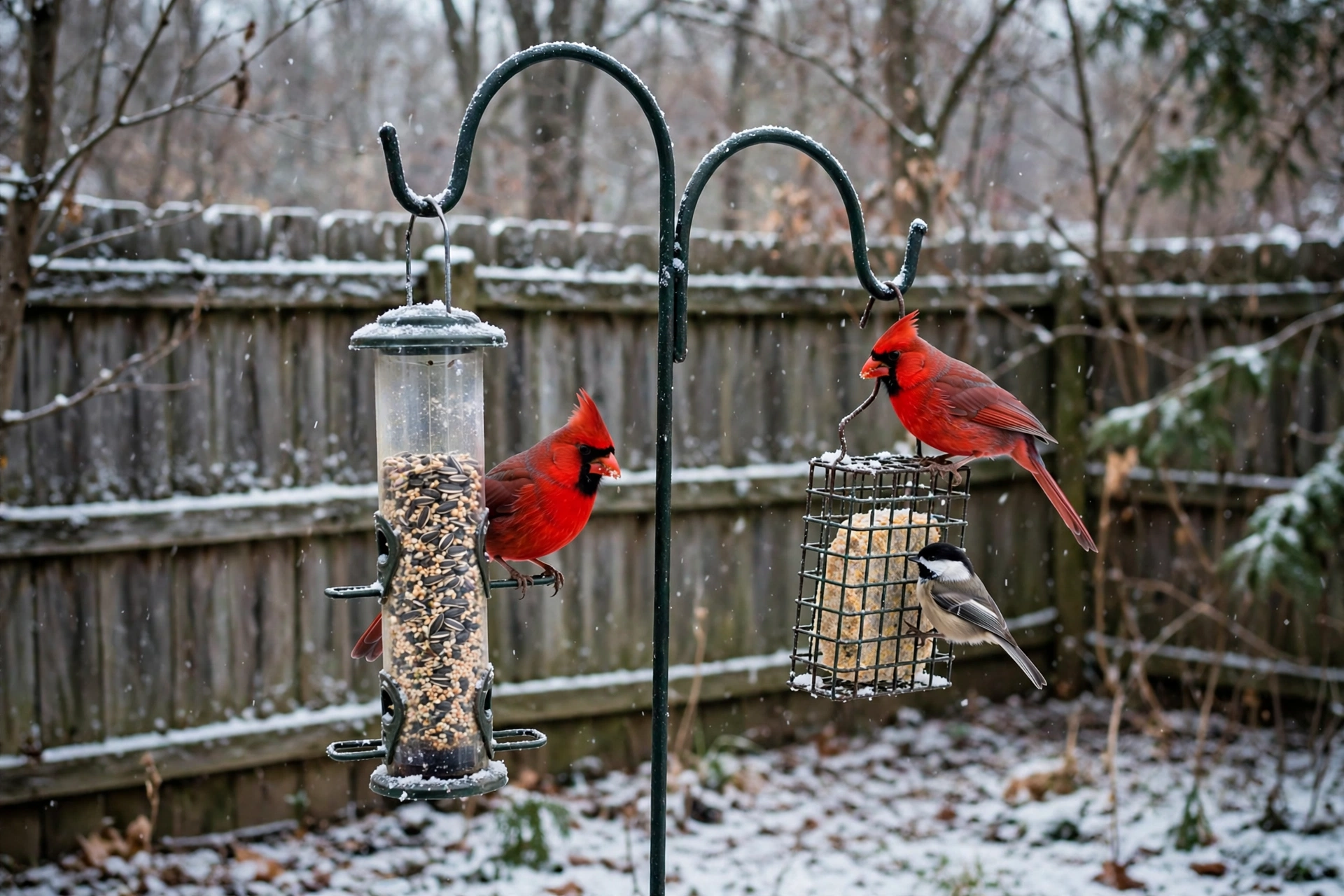
Birds work hardest to find food and open water in winter, and a well-stocked feeder makes a difference to them then. This guide covers which seeds bring which birds, how to handle suet, and how to keep water open when everything freezes. It finishes with the yard’s other insect-eater: bats, which a bat house hung this winter can bring in for summer.
This guide contains paid links. As an Amazon Associate I earn from qualifying purchases.
Start with one seed: black-oil sunflower
If you put out one food, make it black-oil sunflower seed. It’s the most common seed offered at North American feeders, and it draws cardinals, chickadees, finches, and sparrows, with the occasional woodpecker (Cornell Lab FeederWatch). The thin shell is easy for small beaks to crack, and the kernel is high in fat, which is what birds need on cold nights.
Then add foods for specific birds:
| Food | Birds it attracts | Notes |
|---|---|---|
| Black-oil sunflower | Cardinals, chickadees, finches, sparrows | The best single choice (FeederWatch) |
| Nyjer (thistle) | American goldfinch, pine siskin, common redpoll | Needs a feeder with very small ports; feed it alone, not in a mix, to avoid waste (FeederWatch) |
| Safflower | Cardinals and other big-billed birds | Most birds prefer sunflower, per FeederWatch |
| Millet | Juncos, sparrows, and other small ground-feeders | Scatter on a low platform or the ground (FeederWatch) |
| Cracked corn | Doves, quail, sparrows | Cheap, and also popular with squirrels |
| Shelled peanuts (unsalted) | Chickadees, nuthatches, titmice | Never salted (FeederWatch) |
| Suet | Woodpeckers and other insect-eaters | See below |
Read the bag. Cheap mixes are often bulked up with milo, a large reddish seed. FeederWatch says milo “is not a favorite of most birds, and the seed often goes to waste,” and recommends avoiding mixes with a lot of it in the East. A bag of straight sunflower often feeds more birds per dollar than a cheap mix, because less of it ends up on the ground.
Suet: the winter food
Suet, usually beef kidney fat, is a good choice for attracting insect-eating birds (FeederWatch). In a Missouri winter, that means woodpeckers, nuthatches, and chickadees. Hang suet cakes in a wire cage.
Winter is suet season because of the cold. FeederWatch warns that suet can go rancid in hot weather unless it’s been specially processed. From November through February it keeps well outdoors.
Water: the thing most yards are missing
In a hard freeze, open water can be harder for birds to find than food. FeederWatch’s guidance:
- In freezing climates, a birdbath heater keeps ice from forming.
- Never add antifreeze. It’s poisonous to all animals, including birds.
- For ground-level baths, add stones or branches so birds can drink without getting soaked, which FeederWatch calls particularly important in winter.
- Change the water every day or two, and scrub the bath weekly.
A heated birdbath, or a heater element in the bath you already have, is the one piece of equipment worth adding for winter. In St. Louis, where winter swings between hard freezes and thaws, it keeps water open through the cold snaps.
Placement and keeping it clean
- Distance from cover: FeederWatch suggests about 10 feet from trees and shrubs. That’s close enough for birds to dart to cover from a hawk, and far enough that a cat can’t ambush from the bushes.
- Squirrels can jump to feeders placed less than 10 feet from a tree or building (FeederWatch).
- Windows: to reduce window strikes, mark glass with repeating patterns, such as dots, spaced no more than 2 inches apart, or install screens on the outside of the window (FeederWatch).
- Cleaning: clean seed and suet feeders every week or two, more often in heavy use or wet weather. For disinfecting, soak cleaned parts 10 minutes in one part bleach to nine parts water (FeederWatch). Rinse well and let them dry before refilling.
- Clean up below the feeder. Rake up piles of hulls and spilled seed now and then, especially in wet weather.
The other half of your yard’s pest control: bats
Winter is a quiet season for bats. Depending on the species, they either migrate or hibernate. The little brown bat is one that hibernates (Bat Conservation International). That makes now the time to put up a bat house, so it’s in place when they come back.
Why you want bats. Most bats can eat up to half their body weight in insects each night, and pregnant or nursing mothers up to 100% (Bat Conservation International). University of Missouri Extension cites the little brown bat catching on the order of 600 mosquitoes an hour. The Missouri Department of Conservation names spotted cucumber beetles, a vegetable garden pest, as a favorite food of the big brown bat.
Which bats use houses here. The big brown bat is one of Missouri’s most commonly encountered bats and lives statewide (MDC; MU Extension). MDC notes that big brown bats are more likely than some other species to use man-made structures, which is what a bat house is.
Bats need the help. White-nose syndrome, first found in a New York cave in 2006, has been confirmed in 12 North American bat species, and bats with symptoms have been found in 35 U.S. states (Bat Conservation International). BCI says some once-abundant North American bats have lost more than 90% of their populations.
Where a bat house goes
Bat Conservation International’s guidelines are specific, and placement matters more than the house itself:
- Height: at least 12 feet of open space below the exits, and higher is better.
- Sun: bats prefer early morning sun and at least 7 hours of sun a day.
- What to mount on: a building is best, a pole is next, and a tree is the worst option. Trees shade the house, block the bats’ approach, and give owls a perch. Mount it on wood, stone, or brick. Bats rarely use houses on metal buildings.
- Color: a darker shade helps a house stay warm in cold climates, and a lighter shade helps it shed heat in hot ones.
- Two is better than one: BCI recommends at least two houses, within about 100 meters of each other if possible.
What to look for in a bat house
BCI favors four-chamber over two-chamber designs, roost gaps of no more than 1 inch, and no screen or mesh inside. Avoid metal and smooth plastic. If you’re shopping for a ready-made house, Big Bat Box is one place to look:
See the bat houses at Big Bat Box
Whatever you buy, check it against those BCI guidelines before you mount it.
Be patient
BCI has seen successful houses take as long as five years to be occupied. MDC suggests moving or modifying a house that’s still empty after two years. MDC also says not to try to “stock” a bat house by catching bats: it rarely works, and capturing bats requires permits.
The bottom line
For winter birds, fill one feeder with black-oil sunflower, add a suet cage, and keep water open with a birdbath heater, never antifreeze. Clean the feeders every week or two, and keep them full through cold snaps. Put up a bat house this winter, 12 feet or higher with at least 7 hours of sun, on a building or pole rather than a tree, so it’s ready when the bats come back in spring.
Bird feeding guidance from the Cornell Lab of Ornithology’s Project FeederWatch. Bat house guidelines and bat facts from Bat Conservation International; Missouri species information from the Missouri Department of Conservation and University of Missouri Extension.