A freeze does most of its damage the first night the temperature drops into the 20s, before anyone has thought about winter. This checklist covers the whole house, from pipes and hoses to gutters and the furnace, and lists the repair bill each skipped job risks so you can decide which ones to do first.
When “first freeze” actually arrives here
In St. Louis, the average first 32°F night is around October 31 (National Weather Service St. Louis, records back to 1874), and the median first hard freeze, 28°F or colder, is around November 15 (NWS St. Louis). Averages hide wide swings. In 2024 the first freeze didn’t come until November 26, one of the latest on record (NWS data via local reporting). If you haven’t done these jobs yet, the season hasn’t given you much margin.
The order below is by cost of failure, not by how long the job takes. Do the top of the list first.
1. Disconnect hoses and shut off outdoor faucets
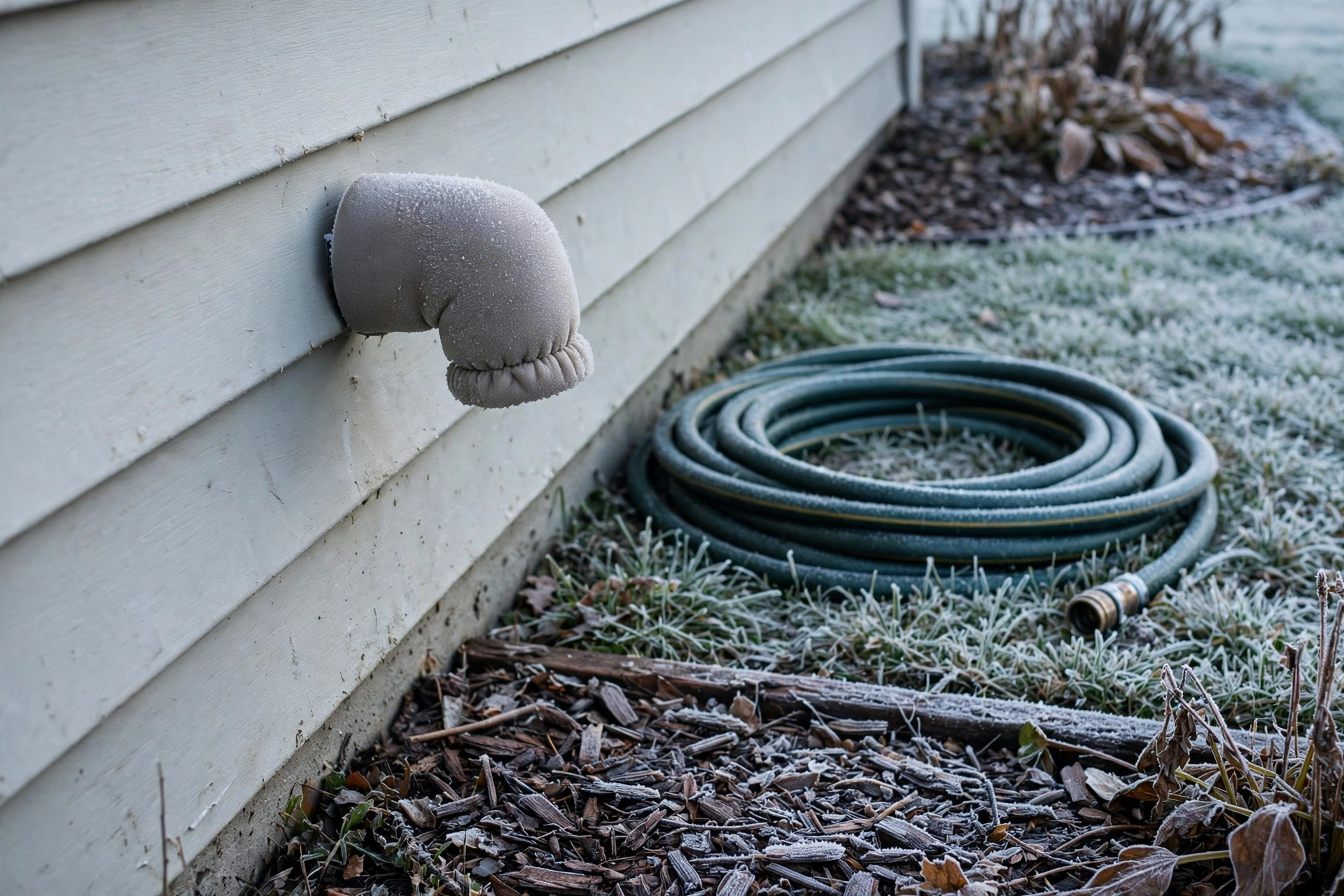
The job: Unscrew every garden hose. If your outdoor faucets have an interior shut-off valve (often in the basement, on the line running to that wall), close it, then open the outdoor faucet to drain what’s left in the pipe.
Why it matters: A hose left attached traps water in the faucet body and the pipe behind it. When that water freezes, it can split the pipe inside the wall. You often won’t see it until spring, when the hose goes back on and the leak shows up in the basement.
What skipping it costs:
– Replacing an outdoor faucet (hose bib): $200–$600, about $300 on average (HomeAdvisor), or $150–$350 with the part itself only $10–$40 (HomeGuide).
– A burst pipe behind that faucet: see item 2.
Cost to do it right: nothing.
2. Insulate exposed pipes
The job: Find supply pipes in unheated spaces, such as crawlspaces, garages, exterior walls under sinks, and attics, and sleeve them in foam pipe insulation.
Why it matters: These are the pipes that freeze first, and a frozen pipe is a burst pipe waiting for a thaw.
What skipping it costs:
– Burst pipe repair: about $500 on average, with a range of $150 to $5,000 (Angi). The high end covers pipes underground or with related water damage.
– If the burst is behind a wall, drywall repair is extra (Angi).
– Water damage restoration: $3,822 on average, typically $1,361–$6,282 (Angi, 2025 data). This is the number that turns a $3 fix into a disaster.
– Even a frozen pipe that hasn’t burst usually costs about $100 to have thawed professionally (Angi).
Cost to do it right: Foam pipe insulation is cheap. Home Depot lists a 6-foot length of ½-inch semi-slit foam at $2.18. A dozen sleeves costs less than one plumber’s visit.
On the coldest nights, open the cabinet doors under sinks on exterior walls and let a faucet on that wall drip. Both are old habits that cost almost nothing.
3. Know where your main water shut-off is
The job: Find the main valve, usually where the water line enters the house, often in the basement on the front wall. Turn it off and back on once so you know it moves. Tag it. Make sure everyone in the house knows where it is.
Why it matters: The difference between a $500 pipe repair and a $3,822 water damage job (Angi) is mostly how many minutes water runs before someone shuts it off. A main valve nobody can find, or one rusted open, turns minutes into hours.
Cost: nothing. If the valve won’t turn, that’s a plumber call to schedule now, in daylight, not at 2 a.m.
4. Clean the gutters after the leaves are down
The job: Clear gutters and downspouts once the trees near the house are bare. Flush the downspouts and make sure they drain away from the foundation.
Why it matters: Clogged gutters hold water. In freeze-thaw weather that water becomes ice, adds weight to the gutters, and can back up under the roof edge.
What skipping it costs:
– Ice dam removal: about $1,200 on average, $650–$2,400 (Angi), and that doesn’t include repairing what the ice dam damaged.
Cost to do it right: Professional gutter cleaning runs $70–$250 for a one-story home and $100–$325 for two stories (HomeAdvisor, for 150–200 linear feet). See our gutter cleaning cost guide for the full breakdown.
5. Get the furnace checked before you need it
The job: Replace the filter. Schedule an inspection if it hasn’t had one in a year.
Why it matters: The furnace runs hardest on the coldest nights, and that’s when a weak part fails.
What it costs:
– Basic furnace inspection: about $80–$100. An advanced inspection with light cleaning and a tune-up runs $125–$200 (Angi).
– A filter is a few dollars. A furnace that fails on a 10-degree night can mean an emergency call and frozen pipes, which takes you back to item 2.
6. Test smoke and carbon monoxide alarms
The job: Press the test button on every alarm. Replace batteries. The National Fire Protection Association’s standard advice is a CO alarm outside each sleeping area and on every level of the home.
Why it matters: Furnaces, water heaters, fireplaces and attached garages all get more use in winter. CO is odorless, and a working alarm is the only way to know it’s there.
Cost: a pack of batteries. This one isn’t about money.
7. Drain and store the hoses themselves
The job: Drain each hose completely, coil it, and store it somewhere above freezing, like a garage or basement.
Why it matters: Water left in a hose expands when it freezes, which stresses the hose wall and the fittings. Hoses also last longer out of winter sun and cold.
Our garden hose buying guide covers which hose types handle cold best.
8. Blow out or shut down irrigation
The job: If you have an in-ground sprinkler system, shut off its water supply and have the lines blown out with compressed air, or follow your installer’s winterization steps.
Why it matters: Irrigation pipes sit shallow, and water left in them can freeze and crack lines, fittings and backflow preventers.
What it costs: We couldn’t find a reliable national price for irrigation blowouts. Local landscapers and irrigation companies quote this each fall, so get a price from yours.
9. Seal the obvious drafts
The job: Check weatherstripping on exterior doors and the door from the garage. Look at the gaps where pipes and cables enter the house.
Why it matters: Cold air coming in near a pipe can freeze a pipe in a “heated” wall.
Cost: a tube of caulk or a roll of weatherstripping.
10. Stage the emergency kit
Flashlights, fresh batteries, the furnace company’s number, and a plan for space heaters if the furnace quits.
The bottom line
The three jobs that prevent the biggest bills cost almost nothing: disconnect the hoses and drain the outdoor faucets, sleeve exposed pipes in a few dollars of foam, and know where the main water shut-off is. Skipping them risks a burst pipe at about $500 on average and water damage at about $3,800 on average (Angi), compared with about $2 per pipe sleeve (Home Depot). Do those three this week, then work down the list.
Freeze dates from the National Weather Service St. Louis office. Repair costs from Angi, HomeAdvisor and HomeGuide published cost data; pipe insulation price from a Home Depot listing. Your quotes will vary. Get them in writing. For gas, electrical or roofing work, hire a licensed pro.